
5 of the most amazing dinosaur fossils ever found

13 September 2024

Over the years, many incredible dinosaur fossils have been discovered. Join us as we run down 5 of the best.


Tyrannosaurus rex skeleton in a museum, displaying large skull, teeth, and rib cage.

How do scientists learn about dinosaurs? The task would be impossible without fossils – those skeletal remains that reveal valuable information about the size, diet and habits of these long-gone creatures.


Fossils have been dug up for centuries, but it began to be taken seriously as scientific research in the 19th century. Many of the world's most famous specimens were excavated around this time.


In this article, we take a whistle-stop tour of five of the most amazing dinosaur fossils in the world. Which one is your favourite?


1. Dippy the Diplodocus

Dinosaur skeleton in a large building with arches, possibly a museum or cathedral.

For more than 100 years, Dippy the Diplodocus was the star of London's Natural History Museum. Beloved by visitors, it was the skeleton that launched a thousand school trips.


But it's not, in fact, the skeleton itself, but rather a plaster cast replica. The real Dippy is more than 4,000 miles away in Pittsburgh's Carnegie Museum of Natural History.


As with many dinosaur fossils, Dippy was discovered in stages. In December 1898, William Harlow Reed found its large thigh bone near Medicine Bow, Wyoming.


The Scottish-American industrialist and philanthropist Andrew Carnegie was a prehistoric patron who financed further excavations and, once the skeleton was complete, donated plaster casts to major museums across the world.


Dippy casts a long shadow in a couple of ways. First, there's the sheer scale of the skeleton: 26 feet long (about the size of a school bus).


Then there's the influence that Dippy had on culture across the world. Dippy was the first dinosaur skeleton that most people at the time had seen. In fact, it's thanks to Dippy that "dinosaur" became a commonly used word.


2. Duelling Dinosaurs

Fossil of a plesiosaur skeleton in a tan stone. The long-necked marine reptile's bones are clearly visible.

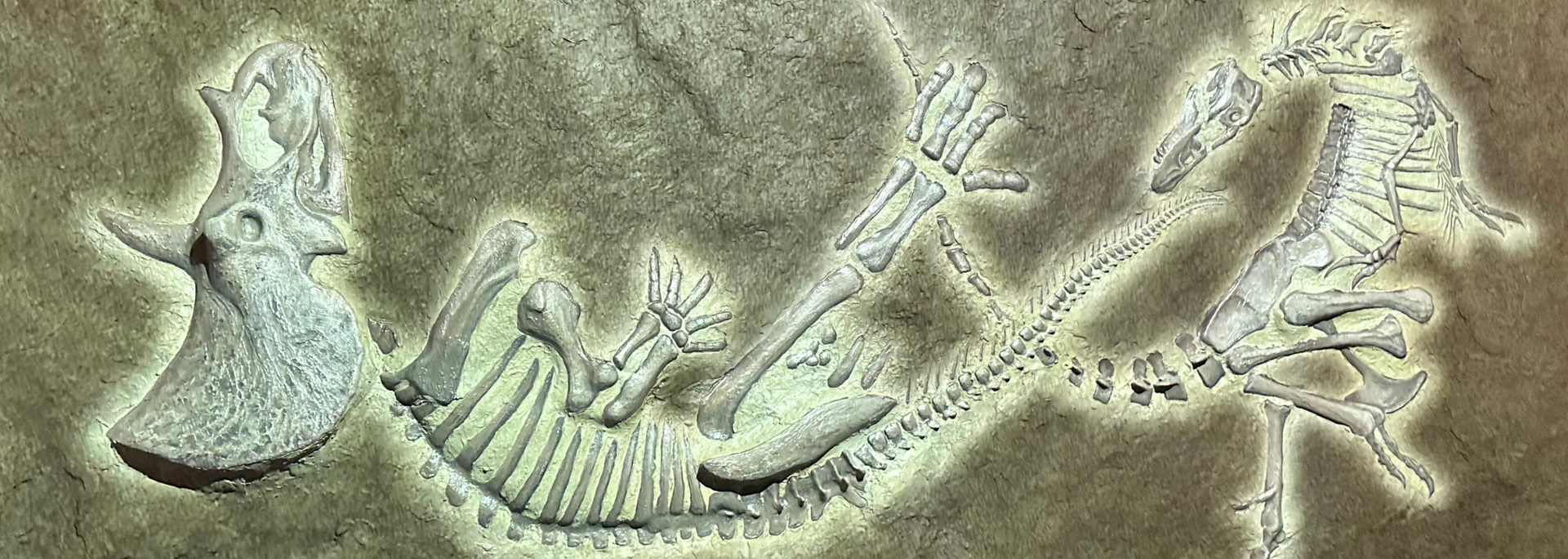
Like insects in amber, fossils capture dinosaurs at the moment of their demise. In the case of the Duelling Dinosaurs found in Hell Creek Formation, Montana, they appear to have been in the middle of a fierce scrap.


This remarkable pair of interlocking skeletons was found by ranchers Clayton Phipps, Mark Eatman and Chad O'Connor. It consists of a young tyrannosaur and a Triceratops , apparently mid-fight.


Both dinosaurs have sustained injuries, with a tyrannosaur tooth deep within the Triceratops skeleton. It's unclear whether they were fighting at the moment of death, or whether they had already collapsed from the exertion.


This prehistoric duel was followed by a modern one, as the property rights to the duelling dinos were disputed at length.


This dispute now resolved, the skeletons can now be seen at the North Carolina Museum of Natural Sciences.


The Duelling Dinosaurs are an unusual find – but they're also extremely useful to scientists, not least because they're such well-preserved and complete specimens of both species.


Another pugilistic pair was unearthed in Mongolia in 1971. Scientists say an avalanche of sand buried a Velociraptor and Protoceratops as they fought, some 80 million years ago.


3. Archaeopteryx

 For a long time, Archaeopteryx – literally "old-wing" – was the oldest known bird. It was crucial to the realisation that birds evolved from dinosaurs.


It lived in the Late Jurassic period around 150 million years ago. At that time, Europe was an archipelago of islands floating in a shallow tropical sea. Archaeopteryx lived in what we now call southern Germany and typically grew to the size of a magpie or raven.


The first Archaeopteryx skeleton to be discovered was the London Specimen, unearthed in 1861 near Langenaltheim. Historians believe it was used as payment for medical services and then sold by the physician to the Natural History Museum in London, where you can see it to this day.


The London Specimen is missing most of its head and neck. Even so, it was an amazing find. The evidence of feathers around the skeleton led scientists to realise the evolutionary link between birds and dinosaurs.


Since 1861, 12 Archaeopteryx specimens have been dug up.


4. Sue the Tyrannosaurus Rex

Skeletal remains of a Tyrannosaurus Rex in a museum setting, displayed against a mural backdrop.

Sue the Tyrannosaurus Rex is a record-breaker in more ways than one.


At more than 40 feet long and 13 feet tall, it's one of the largest Tyrannosaurus rex fossils ever found. It's also one of the most complete, with 250 of its 360 bones intact. What's more, it's the most expensive, auctioned to the Field Museum of Natural History in Chicago, Illinois for an astonishing $8.63 million.


Sue was discovered by its namesake, the palaeontologist Sue Hendrickson, in August 1990 on a cattle ranch in South Dakota's Cheyenne River Sioux reservation.


Its discovery sparked a long-running dispute between the landowners, a Sioux tribe, the US Department of the Interior and the Black Hills Institute.


Eventually, some 67 million years after its death, Sue took its place in the Museum, where it can be seen to this day.


5. Ichthyosaur having babies

 Ichthyosaurs are a kind of predatory fish – and their fossils pop up all over the place. The first was discovered by Mary Anning in Dorset, England, in 1811. A near-complete skeleton was found as recently as 2017.


In South Majiashan, China, however, a remarkable fossil was found – or fossils, rather. Around 150 miles east of Shanghai, a 248-million-year-old ichthyosaur was found, fossilised forever in childbirth.


This ichthyosaur was carrying at least three babies. One was found under her body, one inside her and one halfway out of the birth canal.


Baby ichthyosaurs have been dug up before. In 2010 in Yorkshire, England, for instance, the skeletons of up to eight babies were found in a fossilised ichthyosaur. But the discovery in South Majiashan was remarkable because it showed the animal mid-labour – and the baby was coming out head-first.


This led scientists to the conclusion that ichthyosaurs gave birth on land rather than in water – a fascinating addition to their understanding of ichthyosaurs.


Today, the ichthyosaur and her doomed offspring are on show at Anhui Geological Museum in Hefei, China.


Looking for a fun and educational family day out? Stump Cross Caverns is a beautifully preserved network of ancient caves hidden deep underneath the Yorkshire Dales. There's loads to explore here – and loads to do. Check out our calendar to see
our fun activities in Yorkshire , including interactive fossil digs for kids!

Share this article

Recent Posts

There are loads of family Christmas events in Yorkshire in 2026. Make room in your diary
by Oliver Pyper • 21 October 2026
There are loads of family Christmas events in Yorkshire in 2026. Make room in your diary for these festive attractions.
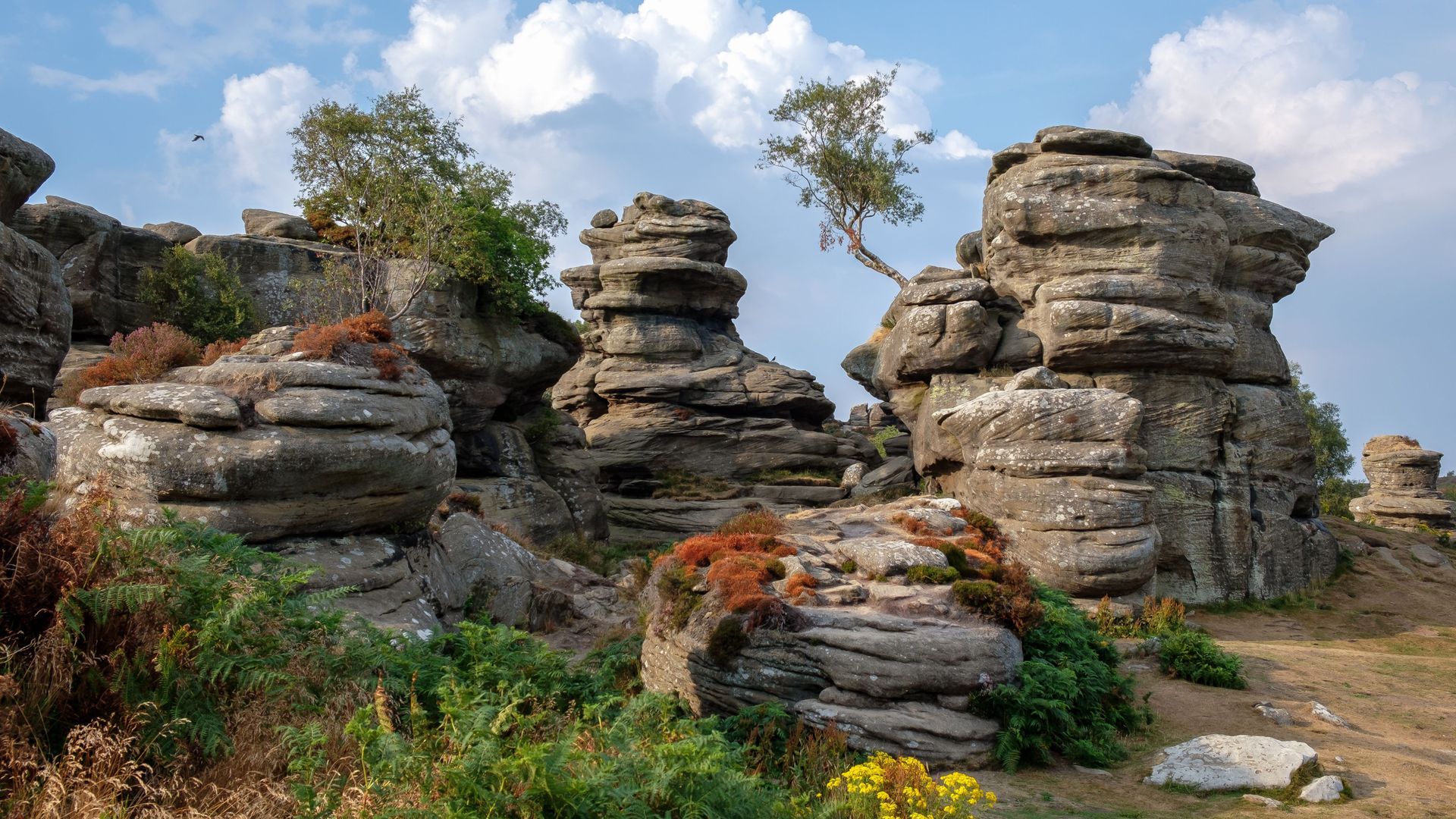
Want to experience the weird and wonderful side of Yorkshire? Discover 11 unusual places to visit
by Oliver Pyper • 12 October 2026
Want to experience the weird and wonderful side of Yorkshire? Discover 11 unusual places to visit for a truly unique day out.

Do you want to take the kids to meet Santa this Christmas? Here are 10 options
by Oliver Pyper • 9 October 2026
Do you want to take the kids to meet Santa this Christmas? Here are 10 options to get the whole family into the festive spirit.
Don't know your druse crystal from your geode? Learn how to spot the difference
by Simon Edward • 5 October 2026
Don't know your druse crystal from your geode? Learn how to spot the difference and identify manmade reproductions.
Cave arches, stacks and stumps are formed over thousands to millions of years.
by Simon Edward • 2 October 2026
Cave arches, stacks and stumps are formed over thousands to millions of years. Learn the fascinating process behind their formation.
Does Mars have caves? Yes! Discover everything you need to know about Martian caves –
by Simon Edward • 28 September 2026
Does Mars have caves? Yes! Discover everything you need to know about Martian caves – no rocket ship required.
Vugs and geodes are both kinds of cavities in rock. How are they different –
by Simon Edward • 21 September 2026
Vugs and geodes are both kinds of cavities in rock. How are they different – and how are they the same?
Looking for hiking inspiration in North Yorkshire? Explore 6 varied walks near Masham
by Simon Edward • 18 September 2026
Looking for hiking inspiration in North Yorkshire? Explore 6 varied walks near Masham on the edge of the Dales.

Looking for KS2 Stone Age homework inspiration? We've got you covered. Discover 6 ideas
by Simon Edward • 14 September 2026
Looking for KS2 Stone Age homework inspiration? We've got you covered. Discover 6 ideas to keep pupils engaged in and out of the classroom.

Show More