
Why do our calcite caves glow under UV light?

Simon Edward • April 26, 2024
BOOK TICKETS

At Stump Cross Caverns, the rocks glow under UV light. But why? Learn all about it in our explainer article.


At Stump Cross Caverns, the rocks glow under UV light. But why? Learn all about it in our explainer article.

Ever wanted to see a cave glow in the dark? At Stump Cross Caverns, you can.


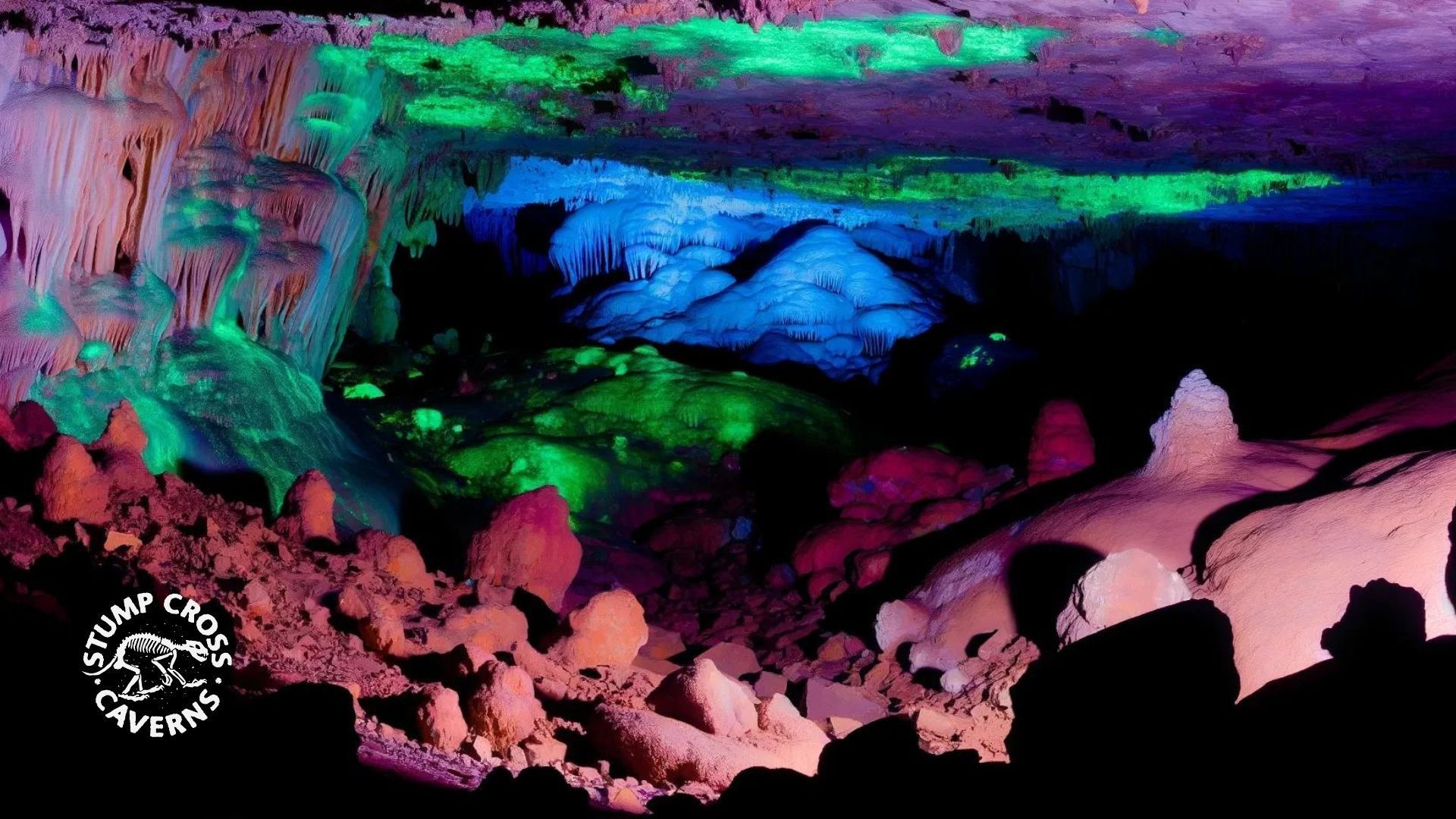
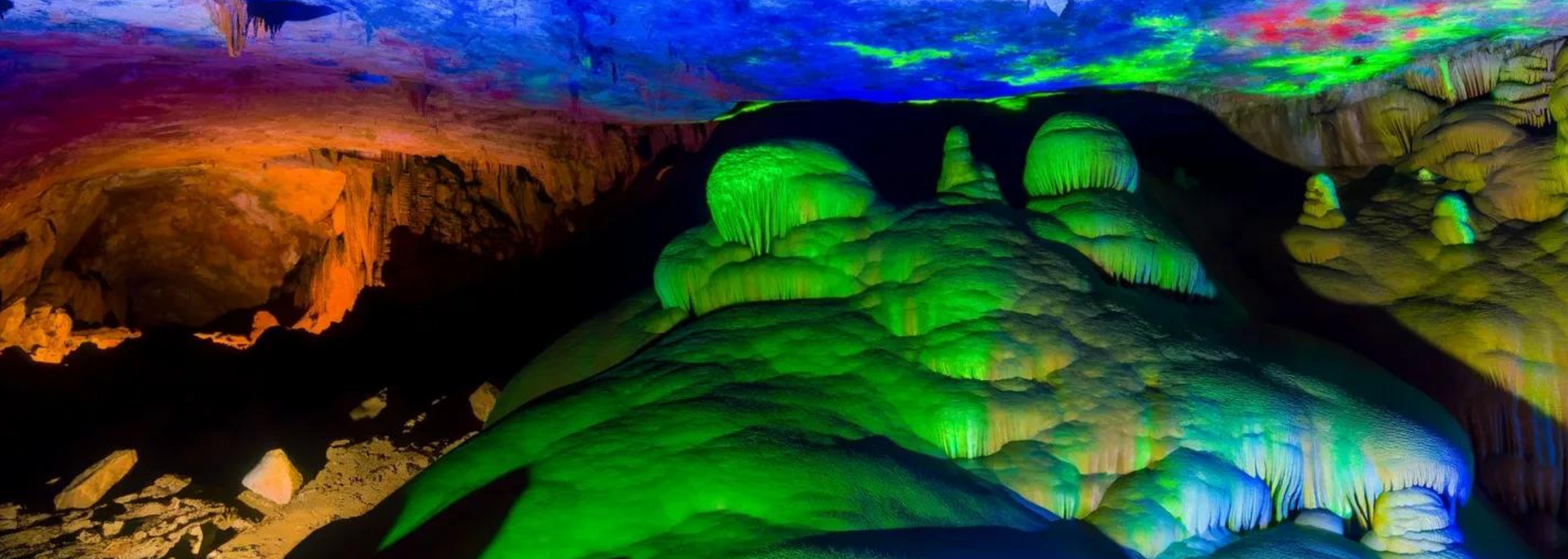
With your ultraviolet (UV) torch in hand, you can see the natural calcite in the rocks light up with a mysterious glow.


The effect is breathtaking. Like an X-ray, the torch uncovers hidden veins and details in the rock that the eye alone can't see.


Don't get us wrong – you don't need a UV torch to experience the magic of Stump Cross. But it adds an extra layer of mystery that visitors love.


But why do the rocks light up like this? It's time for a quick science lesson.


What is fluorescence?


Stump Cross Caverns is a network of limestone caves that's bursting with stalagmites, stalactites and other rock formations. These are formed when rainwater seeps through the soil and leaves calcite traces in the rock.


Over thousands of years, these calcite deposits can become rock formations. This means the walls of Stump Cross are imbued with calcite crystals.


Calcite is fluorescent. That doesn't mean that it's brightly coloured like a fluorescent marker or a fluorescent T-shirt. It means that it produces light by a process called fluorescence.


When you shine your UV torch on the walls and formations of Stump Cross, you're watching an atomic reaction take place.


The atoms inside a fluorescent mineral like calcite are orbited by electrons. This orbit is regular and steady until it's struck by UV light. This ray of light puts the electrons in a spin.


When the electrons calm down after this disruption, the energy they've absorbed from the UV light is transformed into a new photon. This new photon is longer than the energy it comes from – and this is perceived by the human eye as fluorescence.


Picture of flourescent walls at Stump Cross Caverns.

When the cavern walls glow under UV light, you're literally exciting the atoms inside them and producing new photons. It feels like a magic trick – but in fact, it's a scientific phenomenon that's been known about for centuries.


A brief history of fluorescence


The earliest known record of fluorescence comes from the 16th century and a type of wood called
lignum nephriticum. When it came into contact with water, it turned a brilliant blue.


Craftsmen would make cups from this wood that would be presented as gifts to royalty. It was also used as a medicine.


The fluorescent properties of minerals, however, weren't uncovered until the 19th century. Different scientists observed it in fluorites, chlorophyll and quinine.


In 1852, the Irish scientist George Gabriel Stokes discovered that fluorspar and uranium glass had the same property. He wrote:


"I am almost inclined to coin a word, and call the appearance fluorescence, from fluor-spar, as the analogous term opalescence is derived from the name of a mineral [(opal)]".


What other rocks are fluorescent?


There are more than 500 minerals known to us that show fluorescence under UV light. However, not all specimens glow every time.


To glow under UV light, minerals need an ion actuator (or ion activator). Different actuators produce different colours.


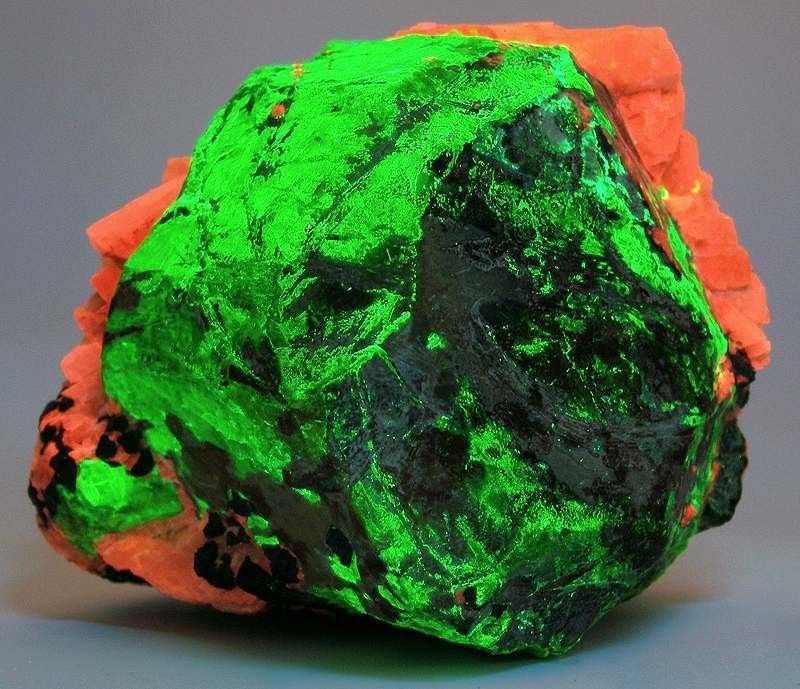
Willemite, for example, will glow green, whereas calcite can fluoresce many colours – red, blue, white, pink, green and orange.


Other fluorescent minerals include scheelite, langbanite and apophyllite.


Multiple minerals can be found in a single rock. Some rocks can have up to half a dozen minerals, each of which will fluoresce differently. These multi-mineral specimens are much prized by collectors.


Sterling Hill: fluorescent capital of the world


In Ogdensburg, New Jersey, there's a disused zinc mine called Sterling Hill. It's world-famous for its huge range of fluorescent minerals.


Today, there's a Museum of Fluorescence located in four rooms of the old mill building. Visitors can gawp at the Color Wall: a floor-to-ceiling display of around 100 fluorescent minerals.


Picture of Willemite crystal at Sterling Hill Mine, Ogdensburg.

The wall is 16 feet wide and contains specimens that can be two to three feet long. Visitors are treated to a lighting display, seeing the wall under longwave and shortwave UV light separately and together. The lights are then switched off and the room is dark save for the mineral's ghostly afterglow.


It's a haven for fluorescent fans and mineral collectors as well as curious non-specialists.


What's the difference between fluorescence, phosphorescence and luminescence?


Fluorescence and phosphorescence are both types of luminescence.


In both cases, the substance absorbs UV light, its atoms get shaken up and a longer wavelength of light is produced. This wavelength is then perceived as a glow.


The difference is simple: if the emission disappears immediately, it's fluorescence. But if it lingers, it's phosphorescence.


Calcite can exhibit both fluorescence and phosphorescence. Often, the fluorescence has a different hue to the phosphorescent afterglow.


When you shine a light on the calcite in Stump Cross Caverns, it glows in the dark. Then, when the torch goes off, it leaves a brief trail behind. This makes our calcite both fluorescent and phosphorescent.


How does the UV tour work?


At Stump Cross, we have two main types of cave experience.


In the mornings and early afternoons, the caves are discreetly lit. You get to see the caves in all their ancient, photogenic glory.


Then at 3 PM, the lights go out and we begin handing out ultraviolet torches.


When you book for the UV Experience, you get to enjoy a fluorescent, glow-in-the-dark, subterranean world.


First, we give you a torch that shines an ultraviolet light.


Now it's time for your descent into the underworld down 65 steps. Once you're down there, shine your torch on the walls and see them in a whole new light. Under the UV light, you can pick out gorgeous veins and details that are otherwise invisible.


It's a mysterious, enchanting experience that you won't forget in a hurry. So, what are you waiting for? If you want to explore a real
glow-in-the-dark cave, book for the Stump Cross Caverns UV Experience today.


Discover great restaurants and eateries near Stump Cross Caverns, from pubs to cafes – all perfect
By Simon Edward April 27, 2026
Discover great restaurants and eateries near Stump Cross Caverns, from pubs to cafes – all perfect for refuelling after exploring the Dales.
Discover Stone Age dietary and dental habits, early methods of cleaning teeth, and what cavemen used
By Simon Edward April 24, 2026
Discover Stone Age dietary and dental habits, early methods of cleaning teeth, and what cavemen used instead of toothpaste.
Discover the best apps for navigating the Yorkshire Dales, with maps, weather and safety tools
By Simon Edward April 20, 2026
Discover the best apps for navigating the Yorkshire Dales, with maps, weather and safety tools to help you explore with confidence.
Discover scenic wild swimming spots in the Yorkshire Dales, with essential safety tips
By Simon Edward April 17, 2026
Discover scenic wild swimming spots in the Yorkshire Dales, with essential safety tips to help you enjoy the water responsibly.
Discover the best rainy day activities in North Yorkshire, from museums to cosy cafes and caves
By Simon Edward April 13, 2026
Discover the best rainy day activities in North Yorkshire, from museums to cosy cafes and caves that are perfect for April weather.
Planning a birthday party for an inquisitive mind? Discover creative ideas
By Oliver Bowerman April 10, 2026
Planning a birthday party for an inquisitive mind? Discover creative ideas to make your child's special day educational and fun.
Get ahead with your weird and wonderful cave knowledge. Learn the amazing answers
By Oliver Bowerman April 6, 2026
Get ahead with your weird and wonderful cave knowledge. Learn the amazing answers to some of the most common questions kids ask about caves.
Discover beautiful wildflower meadows in the Yorkshire Dales this spring
By Simon Edward March 31, 2026
Discover beautiful wildflower meadows in the Yorkshire Dales this spring – from limestone valleys to hay fields near Stump Cross Caverns.
Discover how Yorkshire does Easter differently, from folk theatre and unique baking customs
By Oliver Bowerman March 30, 2026
Discover how Yorkshire does Easter differently, from folk theatre and unique baking customs to springtime sparkle beneath the ground.
Discover where you might find fossils in Yorkshire, and how to explore responsibly while protecting
By Simon Edward March 27, 2026
Discover where you might find fossils in Yorkshire, and how to explore responsibly while protecting the prehistoric heritage of the region.
More Posts