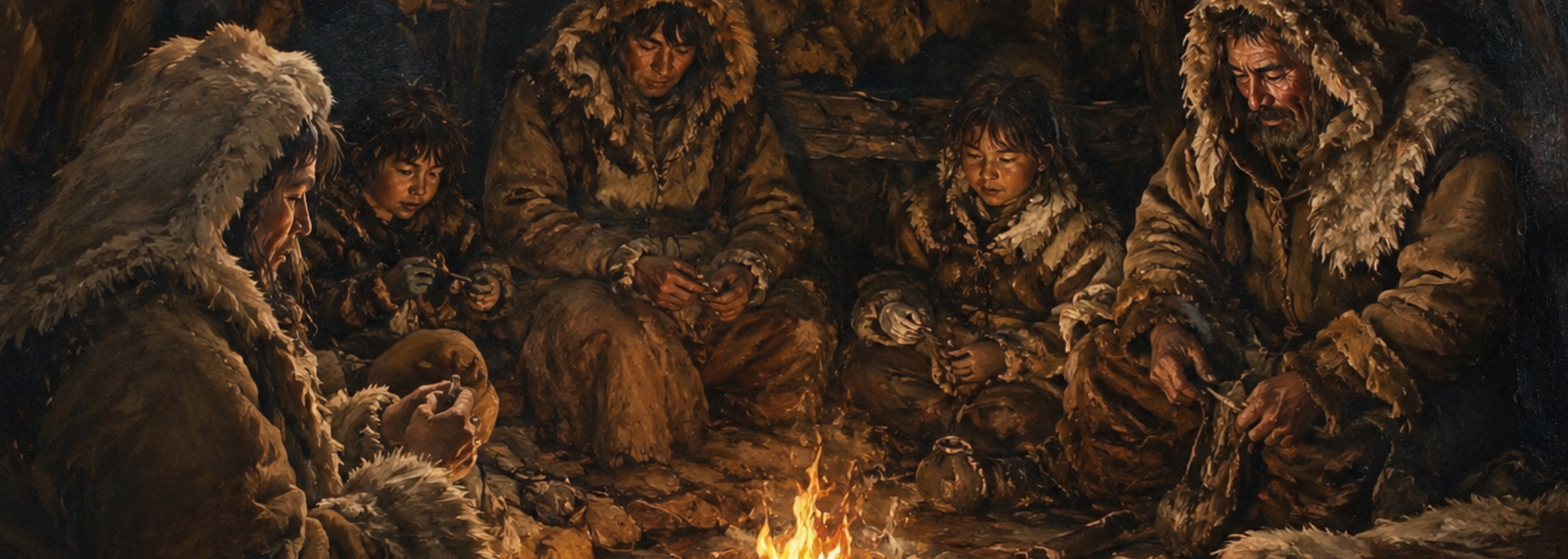
How did cavemen and women survive the Ice Age?
The Ice Age saw the last of many giant beasts – so how did early humans survive? Discover how clothing, shelter and diet played a part.

The Ice Age ended some 11,000 years ago with a whole lot of melting brought on by a warming climate.
But it wasn't just masses of ice that left the planet – it also caused a number of species to go extinct.
These were mostly large-bodied mammals (sometimes called "megafauna"), including species such as woolly mammoths, mastodons, sabre-toothed cats, giant ground sloths, woolly rhinos and dire wolves.
So, how did humans survive? What did our distant ancestors have that let us thrive for another 10,000 years or more?
There's no one answer to the question. Cavemen and women didn't survive the last ice age because of a single superpower or environmental adaptation. Instead, our longevity is down to a range of factors: from clothing to shelter, from tools to diet.
Clothing
The story of Ice-Age humans is told through many things, most obviously fossils and DNA. But it also comes from ancient art.
In Russia, sculptures from 24,000 years ago show people wearing clothes resembling tailored parka jackets.
This is just one example of the tailored clothing that helped early humans through the ice ages. Tens of thousands of years ago, our ancestors were using stone needles to tailor multilayered clothes from animal skins.
And if you're imagining a person loosely draped in a reindeer skin, think again. Many of these clothes were form-fitting, enabling people to stay insulated in brutal conditions.
Of course, body insulation alone didn't enable humans to survive the last ice age. If that were the only deciding factor, woolly mammoths and other hairy beasts would have survived, too. As well as protective clothes, early humans were adept at making protective shelters.
Shelter
When the climate is cold, you need somewhere warm to live. Part of the reason we survived the last ice age is that we built highly insulated dwellings, often from mammoth bones, hides and earth.
This not only kept them safe from sub-zero temperatures and fierce winds. It also meant they could light indoor fires that helped them conserve body heat and stay warm and dry.
Moreover, it meant they had somewhere to keep their food supplies in the winter months. Early humans would stockpile dried meat and fish to get them through the harsh, cold winters when there was little fresh food to forage.
These shelters were cosy but by modern standards a little too cosy. They were often small and shared by lots of people within a community. This may have been difficult for them, but it also allowed them to share body heat.
Whatever the weather outside, early humans could sit by a fire in an insulating shelter, wrapped in form-fitting, tailored clothing.
None of this, however, would have been possible without tools.
Tools
The history of humans is the history of tools. After all, the Stone Age, Bronze Age and Iron Age are all named after the primary materials used to create tools. These tools were used for everything from building to tailoring to hunting.
The last ice age occurred during the long, long Stone Age. This means essential tools were made from stones – and often, it involved using one stone tool to create another.
We've already seen how stone tools enabled early humans to tailor clothes and build shelters. It also led to the invention of bone harpoons and spearheads that were used to hunt large game.
These kinds of creative weapons were used to hunt animals such as reindeer and mammoths. These provided meat for food, hides for shelter and bones for tools and even musical instruments.
Meanwhile, stone flakes were used to process meat, clean hides for clothing and remove marrow from bones.
Our survival as a species would have been much, much harder without tools – and in the case of the final ice age, might have killed us off altogether.
Social networks

Despite what the history books might tell you, humans are a fundamentally cooperative species. This talent for cooperation is one key reason why our ancestors survived the last ice age.
When the going got tough, whether because of a harsh, changing climate or food scarcity, human clans communicated and exchanged resources.
These resources included stone tools, obsidian and food. Evidence reveals that these kinds of resources were exchanged over vast distances – in some cases, around 400 miles (about the distance from London to Edinburgh!)
Mating played its part, too. Marriage partners were exchanged over long distances. This kept the population genetically healthy and spread the use of new technologies such as needles.
These social networks differentiated us not only from the animals that died out but also from human-like species such as Neanderthals. Without them, we may have gone the way of the woolly mammoth.
Diet
Last but not least, cavemen and women survived the last ice age thanks to a high-fat and nutritious diet.
The consumption of large game meat, tubers, seeds and roots provided essential calories for heat. Meanwhile, adaptations such as high omega-3 consumption helped our ancestors survive the devilish cold.
In coastal areas, clans would eat fish, seals and shellfish, while inlanders would hunt reindeer, woolly mammoths and other meaty megafauna.
This last factor is a great example of the interconnectedness of human survival. The diet was intimately connected with the development of tools for hunting, cooking and processing. Meanwhile, social networks allowed early humans to store and share their spoils more effectively.
When was the last ice age?
The last ice age began approximately 115,000 to 120,000 years ago. It ended about 11,000 years ago.
The coldest part of this period was between 20,000 and 26,000 years ago. This "Last Glacial Maximum" was a time when glaciers covered huge areas of present-day Europe and North America.
Here at Stump Cross Caverns, we love learning about our ancient ancestors. Would you like to find out more about Stone Age life? Try our fun and interactive Stone Age activities today.