
How to survive the Stone Age: a time traveller's guide
What skills and tools would you need to survive as a Stone Age person? Take a trip in our time machine and find out…

If there's one thing we get wrong about the Stone Age, it's that Stone Age people were fundamentally different from us.
This is partly because of the way Stone Age people are usually depicted in cartoons, films and books: hairy, lumbering brutes with bones in their hair.
In fact, archaeological evidence shows that Stone Age people were just like us, more or less. They painted on cave walls – and some of those paintings told stories. They played music on flutes and pipes made from animal bones.
The big difference between your average person in the UK today and your average person in the Stone Age is the level of threat you face.
That's not to say that people don't struggle, scrimp and strive today. But in the Stone Age, you were truly on your own. You had to hunt for your own food, make your own tools and weapons, light your own fires and dress your own wounds.
This meant people tended to live in small, tight-knit communities. This could be a family unit or a band of 25 to 50 people. It also meant people moved from place to place looking for food and shelter.
Imagine you stepped into a time machine and found yourself emerging into Stone Age Yorkshire. What skills and tools would you need to survive? Here are six essentials.
1. Find food
No supermarkets. No agriculture as such. Stone Age people relied on each other to hunt, gather and find water.
Today, we have a lot of choice over our diets. In the Stone Age, however, vegetarianism, veganism and other diets weren't an option.
Instead, people lived off fish, birds, deer, boar, mammoths and other animals. They would hunt for these with rudimentary tools.
They also lived off berries, nuts and roots. Today, we have scientists, governments and other bodies to tell us which plants are safe to eat. Back then, you had to figure that out for yourself.

The same goes for water. Stone Age people had to find fresh water sources like rivers and streams, make sure the water was clean and carry it home in containers they'd made themselves.
2. Make tools and weapons
Hunting and gathering is difficult. And unlike today's world, where tools can be bought in shops, Stone Age people had to make their own tools and weapons for the job.
Spears were made by sharpening sticks. Scrapers, hand-axes, arrowheads and harpoons were made by flint knapping. This involves shaping pieces of flint by striking them against each other or with another stone or antler.
By now, it should be clear that materials were limited. This was the Stone Age, after all. People hadn't yet discovered how to process metal. If it couldn't be found in the natural world, it wasn't an option.
3. Stay warm and dry
OK, so you've got your tools and weapons and you've had a good day's hunting and gathering. But where on Earth are you going to sleep?
Stone Age people are often called "cavemen" and "cavewomen". This is because they would look for existing shelters, such as caves, to sleep in. We know this from human remains found in caves and paintings on cave walls.
You couldn't always find a cave or other hole to sleep in, though. Sometimes, you would be forced to build a shelter from branches, mud, grass and animal skins.
The same went for clothes. Animals weren't just killed for food. They were also killed so their fur and skin could be used for clothes. It all sounds like a lot of work, doesn't it?
4. Make fire
Time to settle down for the night. With central heating thousands of years away, you had to make do with a homemade fire – and you couldn't pop to the shops for firelighters and matches.
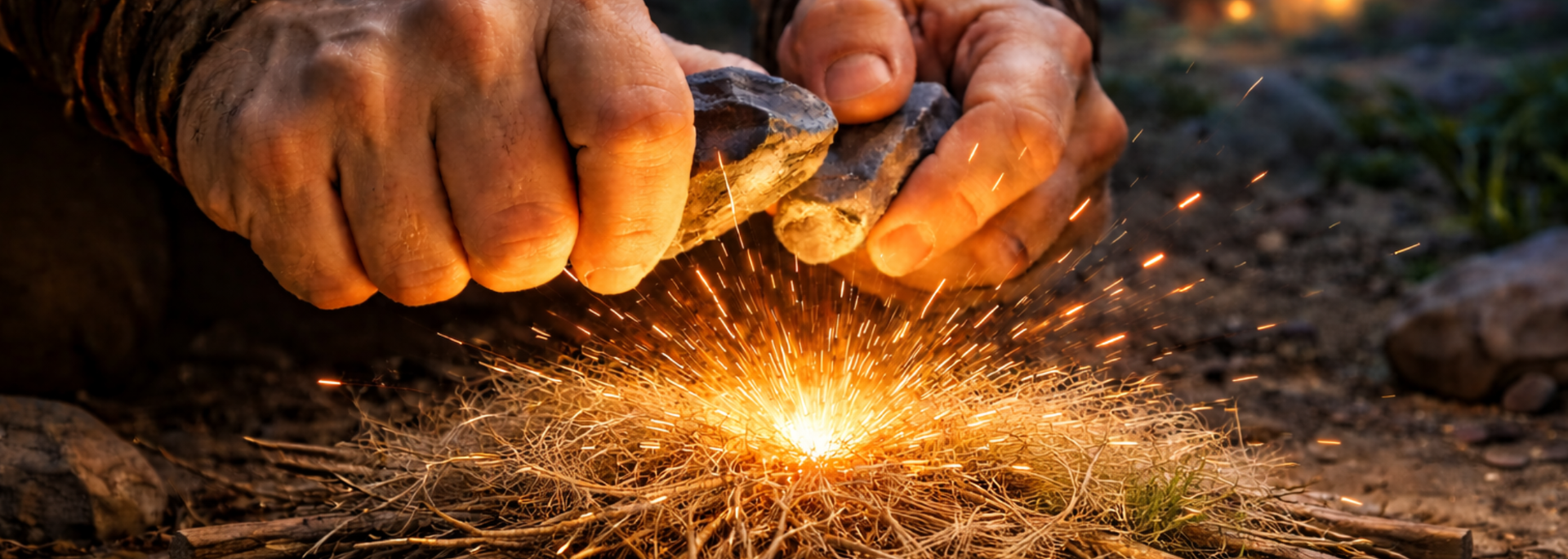
Stone Age people had two main methods. The first was to strike sparks from flint or pyrite onto tinder. The second was to rub wood until an ember formed.

Both methods required skill, materials and above all,
patience. In fact, you could say that patience is the most important skill for Stone Age people. Lose patience, and you put yourself, your family and your band at risk.
5. Build a community
The Stone Age is often portrayed as a dog-eat-dog kind of epoch.
This is true – up to a point. Yes, resources were fought over and groups looked after their own interests. But within those groups, a high level of cooperation existed.
It makes sense. If you need to work hard every day for the bare essentials, you'll need to work in a pack. Cooperation and resourcefulness are the names of the game. This can be seen in the fact that both men and women hunted animals for food, clothing and materials for tools and shelters.
And while we have little evidence of how children were raised, it seems likely that Stone Age communities were like modern-day hunter-gatherer societies. Children were probably raised communally by their parents and multiple "alloparents" (caregivers).
6. Know your environment
In the Stone Age, you won't last five minutes if you don't know your environment. That includes knowing which plants are safe to eat and which animals you can hunt. But it also means predicting weather patterns and the changing of the seasons by tracking the Sun and Moon.
After all, it's this awareness of the environment that meant Stone Age people could eventually develop basic agriculture and animal husbandry. And without those skills, human societies as we know them today would never have come about.
Do you think you have what it takes to survive the Stone Age?
Here at Stump Cross Caverns, we love learning about the Stone Age – we even have our very own resident Cavewoman! If you're a young history buff, why not try our Key Stage 2 Stone Age activities?