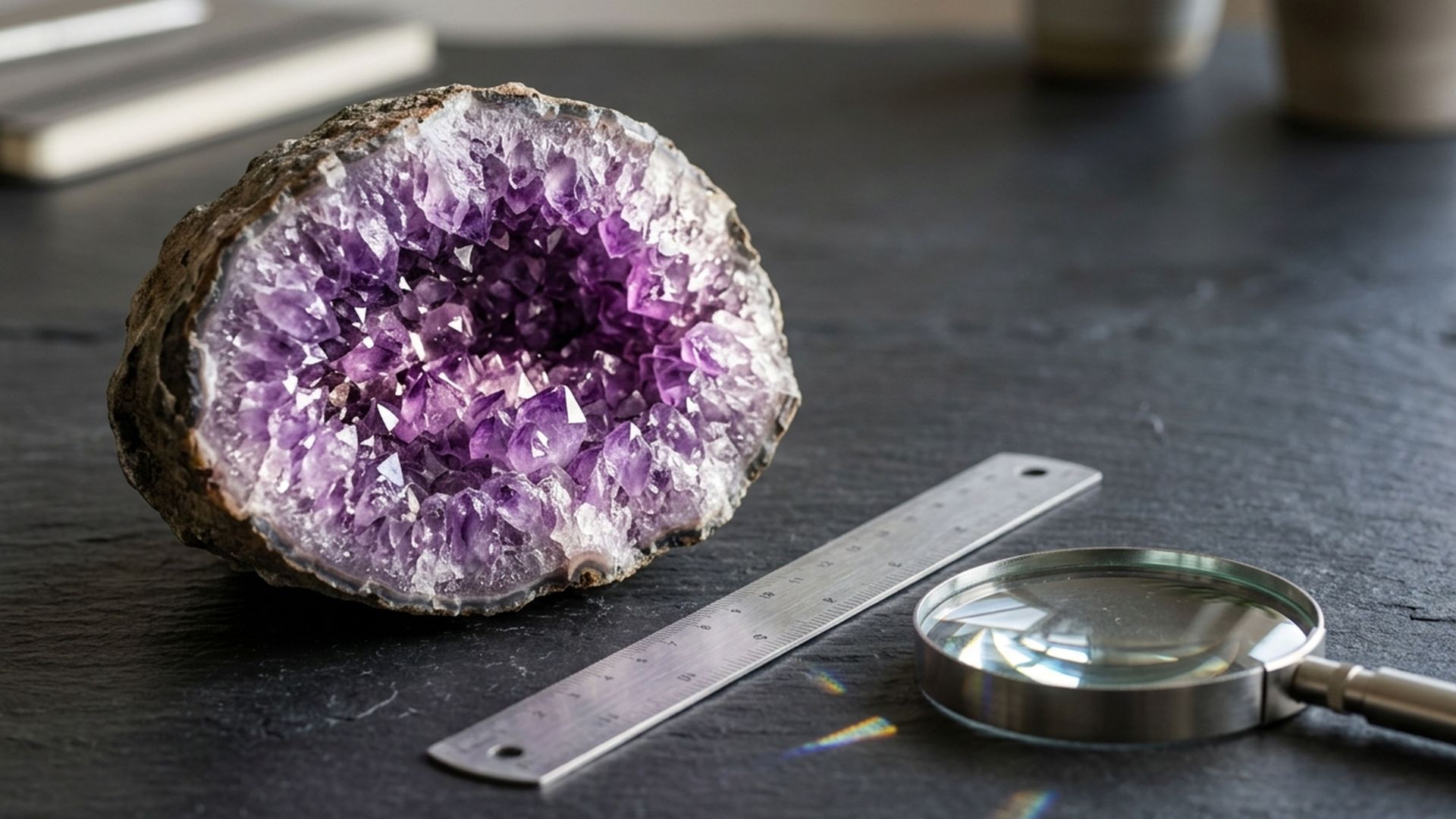
These clues can be difficult to spot if you're relying on a handful of online photographs. If you're buying an expensive specimen, ask for close-up images or video and look carefully at any areas you're unsure about.
1. Look at the colour
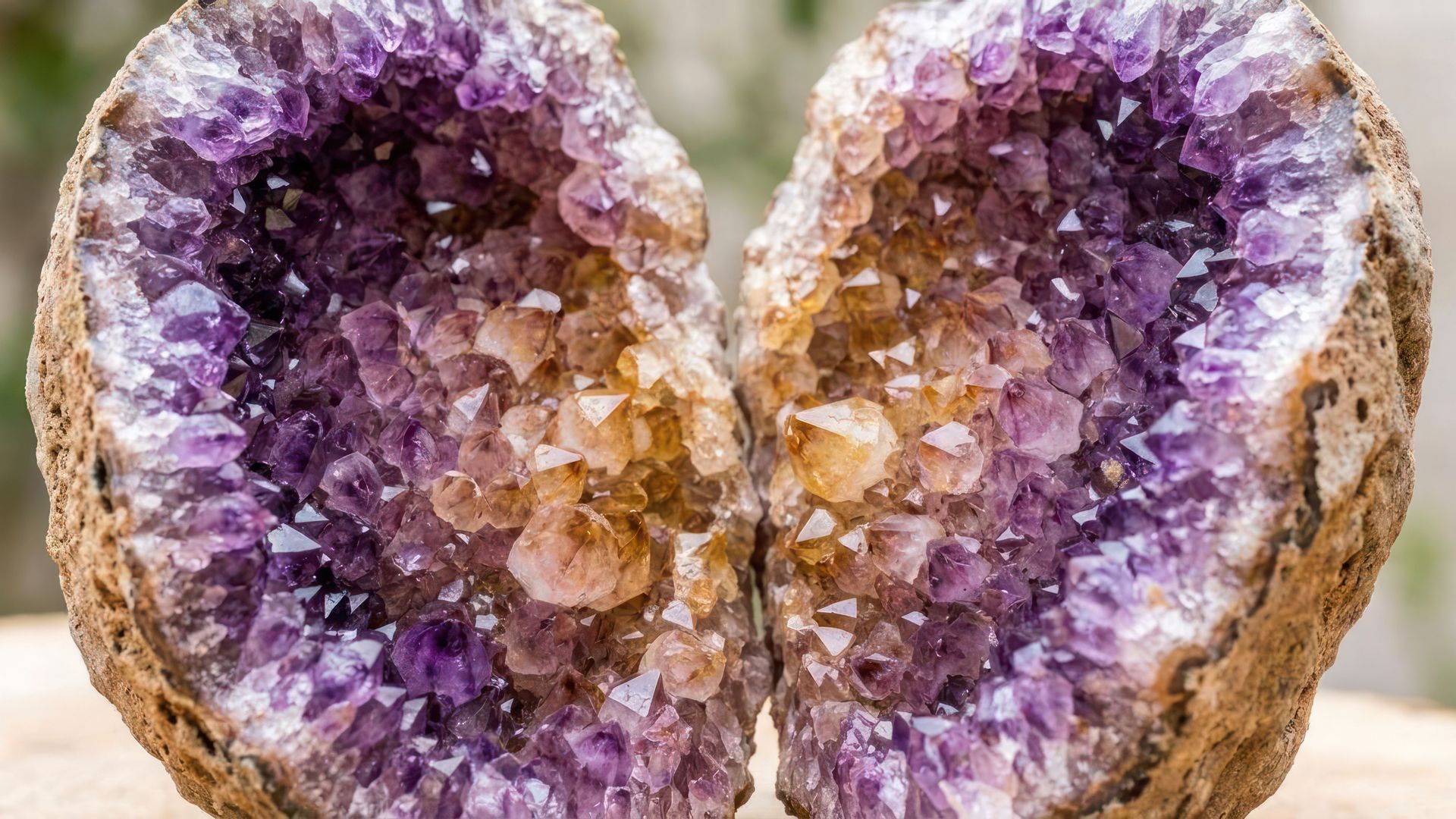
Natural amethyst comes in many shades of purple. Some specimens are deep violet, while others are much paler.
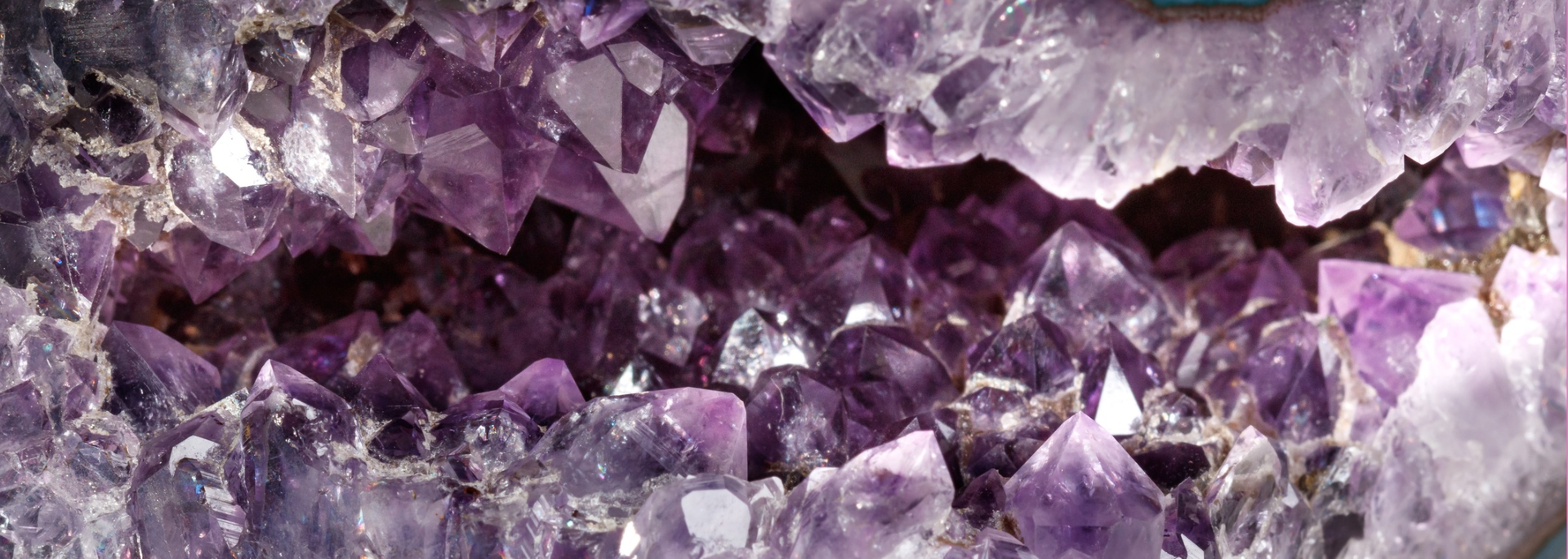
You may also see colour zoning, where some parts of the crystal are darker than others. Natural amethyst can show distinct areas of lighter and darker purple.
An unusually bright or completely uniform purple doesn't automatically mean a specimen is fake. However, it can be a reason to look more closely.
Ask yourself whether the colour appears to be part of the crystals themselves or whether it looks as though it has been added to the surface.
And if you're buying online, remember that photographs can be edited or heavily saturated.
2. Check for dyes and treatments
Not every brightly coloured geode is trying to fool you.
Quartz and other gem materials are sometimes dyed or treated deliberately to create decorative pieces. These can still be attractive objects in their own right – and there's nothing wrong with buying one if you like the look of it.
However, problems arise when dyed quartz is sold as naturally coloured amethyst. Both light-coloured quartz and lower-quality amethyst can be dyed to give them a deep, rich purple shade.
Look closely at cracks and crevices. Dye can sometimes collect more strongly in these areas, creating patches of unusually intense colour.
If you're unsure, simply ask the seller whether the specimen has been dyed, coated or otherwise treated. A reputable seller should be happy to tell you.
3. Can you see bubbles?
If you can, you might not be looking at natural amethyst. Gas bubbles are far more typical of glass or resin imitations than natural quartz crystal.
Get your magnifying glass out and take a close look. If you see rounded bubbles trapped inside the material, that can be a clue that it's man-made.
Natural quartz is more likely to contain tiny minerals or fractures than obvious air bubbles.
4. Look at the shape of the crystal points
Natural crystal growth is rarely perfectly neat.
Inside a real amethyst geode, you'll usually see crystals of different sizes growing at slightly different angles. One large crystal might sit alongside lots of smaller ones.
If every crystal point appears identical, repeated or suspiciously uniform, it's worth looking more closely.
That alone doesn't prove a geode is an imitation. However, combined with unusual colour or an unnatural-looking surface, it can be a warning sign.
5. Look for natural mineral layers
Take a close look at the area between the outer rock and the purple crystals. Natural geodes often show layers of different minerals or materials between the host rock and the crystal-lined centre.
What matters most is whether those layers seem to flow naturally into one another.
If the purple surface looks as though it has simply been painted or stuck onto another material, you may be looking at a coated or manufactured piece.
Again, that doesn't automatically make it worthless. Decorative pieces can be great fun. You simply want to know whether you're buying a natural specimen, a treated one or an imitation.
6. Check the outer rock
Part of the appeal of a natural geode is the contrast between the fairly ordinary-looking rock outside and the crystals hidden within.
A genuine amethyst geode may have a rough outer surface, followed by bands of minerals such as chalcedony or agate before you reach the crystal interior.
Don't expect every geode to look identical, though. Natural specimens vary enormously depending on where and how they formed.
You're looking less for one "correct" pattern and more for signs that the outer rock, mineral layers and crystals belong together naturally.
7. Ask where it came from – and whether it's been treated or repaired
If you're spending a significant amount on an amethyst geode, ask the seller about its origin.
Brazil and Uruguay are famous sources of amethyst geodes. However, even if you know where a geode came from, that doesn't prove that it's natural.
The more information you have, the better. So, ask the seller plenty of questions. Ask whether it has been:
- Dyed
- Coated
- Repaired
- Stabilised
- Painted
- Otherwise treated
None of these things necessarily makes a specimen "bad". Treatments are common across the wider gem trade, and some are used simply to improve appearance or durability.
The most important thing is that the seller
tells
you about these treatments – especially if you ask directly.
After all, once you know the facts, you can decide whether a specimen is right for you.
Does "treated" mean "fake"?
This is where the language around "real" and "fake" can get confusing.
A genuine quartz geode that has been dyed is still a real geode. What has changed is its colour.
Similarly, a natural specimen may have been repaired, polished or stabilised without becoming an imitation.
A completely man-made resin or glass object designed to resemble amethyst is different again.
The useful question isn't always simply "Is this fake?" It's, "What is natural, what has been altered and has that been explained clearly?"
If you're buying something because you love the way it looks, a dyed or decorative geode may be exactly what you want. But if you're buying a specimen because you specifically want naturally occurring amethyst, you'll want to check more carefully.
A cracking good time at Stump Cross Caverns