Very creepy crawlies: the biggest prehistoric insects

Jeric Silva • 6 November 2026

Giant dragonflies, monster mayflies and enormous cockroaches… Meet some of the biggest prehistoric insects ever to crawl across Earth.


Giant dragonflies, monster mayflies and enormous cockroaches… Meet some of the biggest prehistoric insects ever to crawl across Earth.

Not a fan of insects? You might want to look away now.

Today, the world's biggest insects include hefty beetles, enormous stick insects and moths with wings as wide as dinner plates.


Impressive? Absolutely.

But travel back around 300 million years, and you could encounter insects on a completely different scale.


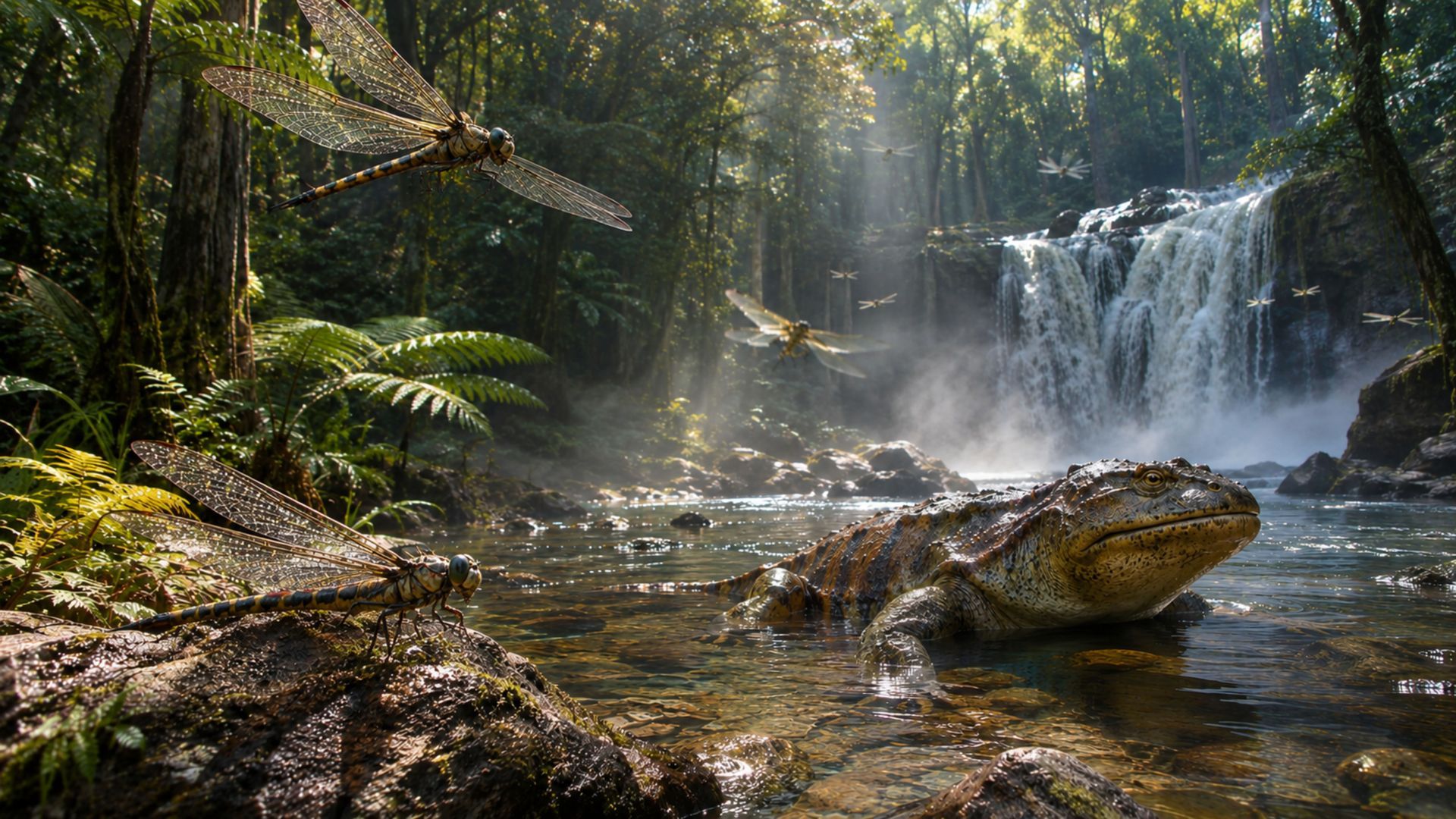
Giant dragonfly-like predators flew over swampy forests. Mayfly relatives had wingspans almost half a metre across. Even cockroach-like insects could reach around nine centimetres long.


And dinosaurs? They hadn't even appeared yet.


Welcome to the strange world of prehistoric insects.


Why were prehistoric insects so big?

First, let's get the facts straight. Not all prehistoric insects were enormous. Plenty were tiny, just as they are today.


During the Carboniferous and Permian periods, however, some species reached sizes that no modern flying insect can match. And one possible reason was the air they breathed.


Today, oxygen makes up around 21% of Earth's atmosphere. During parts of the Carboniferous, around 300 million years ago, oxygen levels may have reached roughly 30% or more.


That's important because insects don't have lungs like we do. Air enters their bodies through tiny openings called "spiracles" and travels through a network of tubes.


With more oxygen in the atmosphere, it may have been easier for bigger insects to get enough oxygen around their bodies.


But that's probably not the whole story. Recent research suggests that oxygen alone can't explain their extraordinary size, and scientists are still debating exactly why some prehistoric insects became giants.


The lack of large flying predators may have helped. Before birds, bats and pterosaurs took to the skies, giant insects had much less competition up there. 


Right now, we just don't know. But whatever the answer, the results were spectacular.


Meganeuropsis permiana – the biggest flying insect ever?


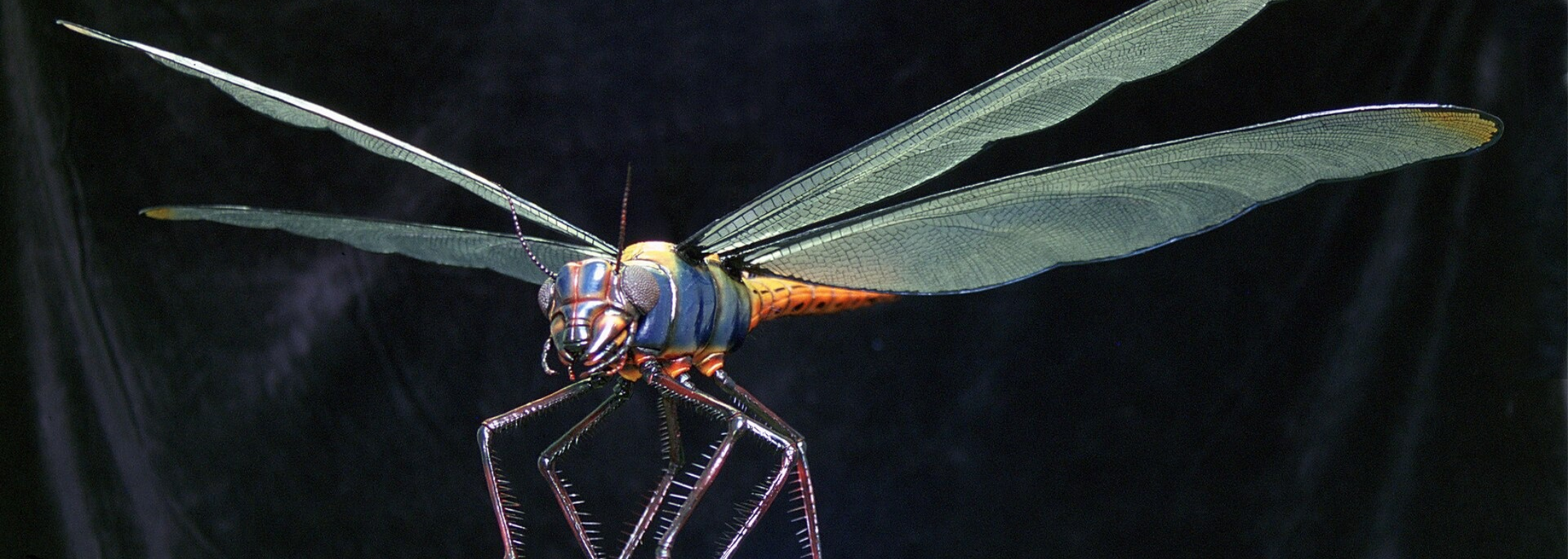
Picture of Meganeuropsis permiana.


Picture a dragonfly.


Now imagine one with a wingspan of around 71 centimetres. That's roughly the width of a small child from shoulder to fingertip.


Meet Meganeuropsis permiana, widely regarded as the largest flying insect yet discovered.


It lived during the Permian Period, around 280 million years ago, in what is now North America. Despite looking like an enormous dragonfly, it wasn't a true dragonfly. It belonged to the extinct group Meganisoptera, sometimes known as "griffinflies".


Fossilised wings show that Meganeuropsis stretched around 71 centimetres from wingtip to wingtip.


And it wasn't simply a gentle giant. Like modern dragonflies, griffinflies were predators. They had large eyes, strong jaws and legs designed to seize other creatures.


Imagine sitting beside a prehistoric swamp and hearing that coming towards you…


Meganeura monyi – the giant of the Carboniferous skies


Picture of Meganeura monyi.


Before Meganeuropsis came another famous giant: Meganeura monyi.

This dragonfly-like insect lived roughly 300 million years ago during the Carboniferous Period.


Its wings stretched around 60 to 70 centimetres across, making it one of the largest insects ever known. It probably hunted other insects over open wetlands and swampy forests, with legs armed with spines that could help trap prey.


So while Meganeura may look rather beautiful in illustrations, smaller insects probably had a different opinion.

Interestingly, giant griffinflies may have preferred open landscapes. An insect with wings that enormous would have struggled to weave neatly between densely packed trees.


Think less "tiny dragonfly darting through a garden" and more "prehistoric flying hunter patrolling a swamp".


Bojophlebia prokopi – the monster mayfly


Picture of Bojophlebia prokopi.


Dragonfly relatives weren't the only insects getting supersized.

Around the same time lived Bojophlebia prokopi, an enormous relative of the mayflies we see today.

Modern mayflies are delicate insects, often spotted dancing above rivers and lakes. Their adult lives can be famously brief.


Bojophlebia, however, was no dainty little river insect. Its wingspan reached around 45 centimetres. That makes it the largest known early relative of modern mayflies.


Like today's mayflies, its young probably lived in water before emerging as winged adults.


So, imagine a Carboniferous pool. Beneath the surface are strange aquatic young. Above it, giant winged insects cruise through the humid air.


Not exactly your average pond-dipping session.

Palaeodictyoptera – the insects with an extra pair of wings


Picture of Palaeodictyoptera.


Now things get really strange.


The Palaeodictyoptera were an extinct group of insects that appeared more than 300 million years ago.

Some were small. Others were enormous.


Species such as Mazothairos may have reached wingspans of around half a metre. And unlike most insects you've seen today, some Palaeodictyoptera had what looked like three pairs of wings.


There were the usual two large pairs used for flying, plus smaller wing-like structures near the front of the body.

They also had long, beak-like mouthparts and are generally thought to have fed on plant juices. The group included some of the largest plant-feeding insects known from the Carboniferous.


Six wings and a giant body? That's a creature even science fiction might struggle to conjure up.


Prehistoric cockroach-like insects

If giant flying insects don't bother you, perhaps enormous cockroaches will.


Cockroach-like insects were already widespread during the Carboniferous Period. In fact, they were among the most common insects in some ancient forests.


These weren't exactly the same as the cockroaches scurrying around today. They were distant relatives with some similar features.


And some could grow surprisingly large.


Fossil examples reached around nine or 10 centimetres long. That's considerably bigger than the cockroaches most of us would ever want to encounter in a kitchen cupboard.


Fortunately, there's no evidence that they had developed a taste for leftover takeaway.


The biggest prehistoric creepy crawlies weren't actually insects


Picture of Arthropleura.


Here's a sneaky bit of science.

We often use the word "insect" for almost any small creature with lots of legs.


But spiders, scorpions, centipedes and millipedes aren't insects at all. They're different kinds of arthropods – animals with jointed legs and hard outer skeletons.


And some prehistoric arthropods made even the biggest insects look modest.


Take Arthropleura.

This giant millipede-like creature grew to well over two metres long and lived around 300 million years ago. It's the largest known land-dwelling arthropod.


Then there's Praearcturus gigas, a prehistoric scorpion whose fossils were found in Britain. Research published in 2026 suggests it grew to more than a metre long, with 16-centimetre-long pincers.


Suddenly, the spider in the bathroom doesn't seem quite so frightening.


How do we know prehistoric insects existed?

Mostly because of fossils.


Insects don't have bones, so preserving one for hundreds of millions of years isn't easy. But under the right conditions, their bodies or wings can leave impressions in sediment that eventually becomes rock.


These fossils let palaeontologists study details such as wing shape, veins, body size and sometimes even mouthparts. From those clues, scientists can work out how prehistoric insects flew, fed and lived.


And new discoveries can still change what we think we know. That's what makes fossil hunting so exciting.


Become a fossil hunter at Stump Cross Caverns

Fancy uncovering your own piece of prehistory?


Here at Stump Cross Caverns, our regular interactive fossil digs let young palaeontologists get hands-on with the ancient world.


The experience begins with an interactive introduction to fossils and prehistoric life. Then it's time to start digging.

Kids can search through sand for real ancient fossils, learn how palaeontologists make discoveries and take their fossil finds home afterwards.


Our fossil digs are designed around Key Stage 2 learning but are suitable for curious fossil hunters of all ages. And you can combine your dig with a journey underground through our ancient limestone caves.


Who knows? Today's fossil-mad youngster might become tomorrow's palaeontologist.


Ready to start digging? Book your fossil discovery dig at Stump Cross Caverns today.


Share this article

Recent Posts

Lechuguilla Cave lay almost completely hidden for millions of years.
by Simon Edward • 1 November 2026
Lechuguilla Cave lay almost completely hidden for millions of years. Discover how cavers finally broke into its extraordinary crystal-filled depths.
What are cave lions and when did they go extinct?
by Simon Edward • 1 November 2026
What are cave lions and when did they go extinct? Learn all about this fascinating prehistoric animal.
Geodes are a wonder of nature, and they contain all manner of gorgeous crystals.
by Simon Edward • 30 October 2026
Geodes are a wonder of nature, and they contain all manner of gorgeous crystals. Learn what kinds of crystals you can find hidden inside.
There are loads of family Christmas events in Yorkshire in 2026. Make room in your diary
by Oliver Pyper • 21 October 2026
There are loads of family Christmas events in Yorkshire in 2026. Make room in your diary for these festive attractions.
Want to experience the weird and wonderful side of Yorkshire? Discover 11 unusual places to visit
by Oliver Pyper • 12 October 2026
Want to experience the weird and wonderful side of Yorkshire? Discover 11 unusual places to visit for a truly unique day out.
Do you want to take the kids to meet Santa this Christmas? Here are 10 options
by Oliver Pyper • 9 October 2026
Do you want to take the kids to meet Santa this Christmas? Here are 10 options to get the whole family into the festive spirit.
Don't know your druse crystal from your geode? Learn how to spot the difference
by Simon Edward • 5 October 2026
Don't know your druse crystal from your geode? Learn how to spot the difference and identify manmade reproductions.
Cave arches, stacks and stumps are formed over thousands to millions of years.
by Simon Edward • 2 October 2026
Cave arches, stacks and stumps are formed over thousands to millions of years. Learn the fascinating process behind their formation.
Does Mars have caves? Yes! Discover everything you need to know about Martian caves –
by Simon Edward • 28 September 2026
Does Mars have caves? Yes! Discover everything you need to know about Martian caves – no rocket ship required.
Show More