Are birds really dinosaurs?
What you've heard is true: birds really are dinosaurs. Explore this fascinating evolutionary story with us.

Do you want to see a dinosaur? You probably don't need to go far. In the UK alone, there are around 84 million of them. There might be one in your garden or on your street. Pop into the local pet shop and you can take one home with you.
No, this isn't a joke. The science is clear: birds are living dinosaurs.
Sure, the dinosaurs we know and love died in the aftermath of the asteroid strike 66 million years ago. But surviving feathered theropods evolved into the birds all around us today.
That means every bird you see shares direct ancestry with dinosaurs like T. rex – from owls to eagles, from blue tits to buzzards. Bird-watchers are actually training their binoculars on a staggering range of dinosaurs.
This isn't to say all dinosaurs were birds. Just as humans are apes but not all apes are humans, so birds are dinosaurs but not all dinosaurs were birds.
If this is news to you, chances are that your mind is as blown as the Gulf of Mexico all those millions of years ago. But even if you're familiar with this startling fact, there are plenty of details that still have the power to surprise and fascinate.
What connects birds and dinosaurs?
The main thing that connects birds and dinosaurs is ancestry. All birds on Earth today evolved from small, meat-eating theropod dinosaurs.
Theropods were a big, diverse group of dinosaurs. They were mostly carnivorous and had two legs, three-toed limbs, clawed hands and hollow bones.
This group of animals (known as a "clade") included Tyrannosaurus rex and Velociraptor. It's incredible to think that all the world's birds descended from these fearsome beasts. And we mean all of them – from garden birds nibbling at seeds to birds of prey circling the skies.
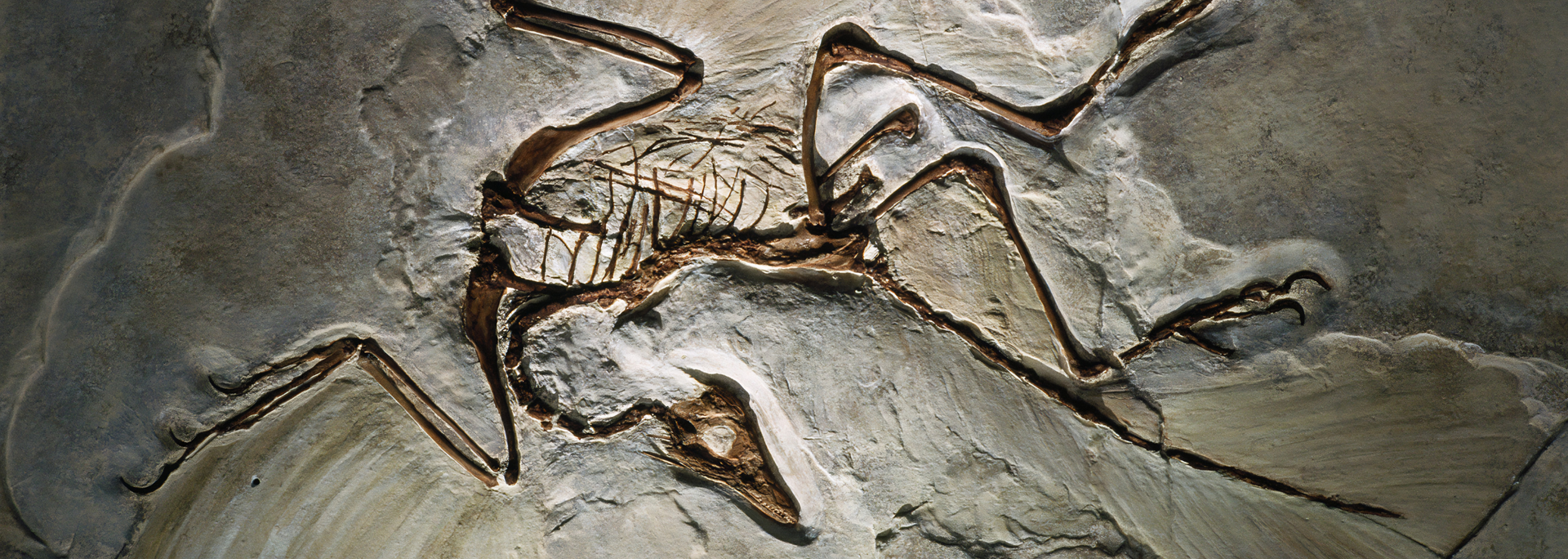
Fossils such as Archaeopteryx show clearly the link between dinosaurs and birds. This was a kind of bird-like dinosaur that lived around 145 million years ago in present-day Germany. Its fossils show both reptilian and bird-like characteristics.
One of these bird-like features was feathers. Like today's birds, Archaeopteryx used its feathers to fly. Other theropods had feathers that were used for insulation, protection and display, but not flight.
Popular depictions of some classic dinosaurs as scaly reptiles are not quite accurate. In fact, dinosaurs like Velociraptor had feathers all over, while T. rex had scales and patches of feathers.
It's not just feathers that connect birds and dinosaurs. It's also the structure of their skeletons. Like theropods, birds have three-toed feet, hollow bones and similar skull shapes.
Why didn't birds go extinct?
"If birds are dinosaurs," you might be wondering, "why didn't they go extinct with the rest of the dinosaurs?"
Well, some of them did. Bird-like dinosaurs that died out in the mass extinction event included the Enantiornithes, the Ichthyornithes and various toothed, beakless birds.
The fact is that large land animals were hit the hardest by the aftermath of the asteroid strike. It was tiny creatures that mostly survived.
Birds are "generalists". This is a zoological term for a jack of all trades – an animal that can thrive in a wide range of environmental conditions.
Larger dinosaurs died in firestorms or perished from a lack of food. However, small birds hid and lived off seeds and insects that survived the asteroid strike.
Why aren't birds the size of T. rex?
The avian dinosaurs that survived the asteroid strike were mostly small. This helped them survive the firestorms and food scarcity that killed off bigger dinosaurs.
Their evolution since then has been characterised by high metabolic rates and delicate skeletons. These helped them thrive – and the story of evolution is the story of animals that survive because of their adaptations.
In other words, birds haven't grown to the size of a T. rex or other famous dinosaurs because they haven't needed to in order to survive.
When did birds start singing?

We know what extinct birds and other dinosaurs looked like because of the fossil record. But did you know that fossils also reveal the point at which they probably started singing?
Birds sing with an organ called the syrinx, found at the base of the windpipe. The fossil record shows that these evolved at least 66 to 69 million years ago.
This means birdsong as we know it today was a late-occurring feature of the theropods that evolved into today's birds.
The oldest fossilised syrinx is 68 to 69 million years old and belongs to the Vegavis iaai. Now extinct, this bird lived in Antarctica and is a descendant of today's ducks and geese.
What is the oldest surviving bird species?
The oldest surviving bird species is widely considered to be the sandhill crane. Native to North America and northeastern Siberia, this large, grey-bodied bird is at least 2.5 million years old. Other contenders to the oldest bird crown include ostriches, hoatzins, cassowaries and emus.
Did any other animals evolve from dinosaurs?
Birds are the only surviving group of dinosaurs that survived the mass extinction event 66 million years ago.
Crocodiles didn't descend from dinosaurs, but they do share a common ancestor. Both belong to the archosaur group, which split into separate lineages in the Triassic period. This means crocodiles are closely related to modern birds.
Turtles tell a similar tale. Both dinosaurs and turtles share a common ancestor in the Archelosauria group. This makes them evolutionary cousins rather than direct descendants the way that birds are.
Could dinosaurs fly?
Yes, some dinosaurs could fly. These include Microraptor, Archaeopteryx and Rahonavis. Pterosaurs are often called "flying dinosaurs", but in fact belonged to a separate group of reptiles.
At Stump Cross Caverns, we love learning about Earth's ancient past. Why not deepen your knowledge of prehistoric creatures by learning all about Stone Age animals? There's a fun quiz to test your knowledge at the end!