Are you looking for evocative poetry about caves? Discover 5 classic examples in our Burns Night guide.

Since 1801, Scots have celebrated Burns Night on 25 January. It's a celebration of Robert Burns, the national poet of Scotland, as well as Scottish culture more generally.
The evening centres on haggis, mashed turnips and potatoes (known as "neeps and tatties"). Folk music is played and whisky consumed. And at most Burns Night celebrations, Burns's poem "Address to a Haggis" is read:
Fair fa' your honest, sonsie face,
Great Chieftain o' the Puddin-race!
Aboon them a' ye tak your place,
Painch, tripe, or thairm:
Weel are ye wordy of a grace
As lang 's my arm.
Burns was a poet with range. As well as his famous ode to a haggis, he penned love poems, narrative poems, landscape lyrics and more.
And perhaps most importantly to us here at Stump Cross Caverns, he also wrote one of the best poems about caves: "Had I a Cave".
We like it so much that it inspired us to gather some other fine poems about caves – from medieval verse all the way to 20th-century pieces. But before we get ahead of ourselves, let's take a closer look at that classic poem by the father of the feast himself, Robert Burns.
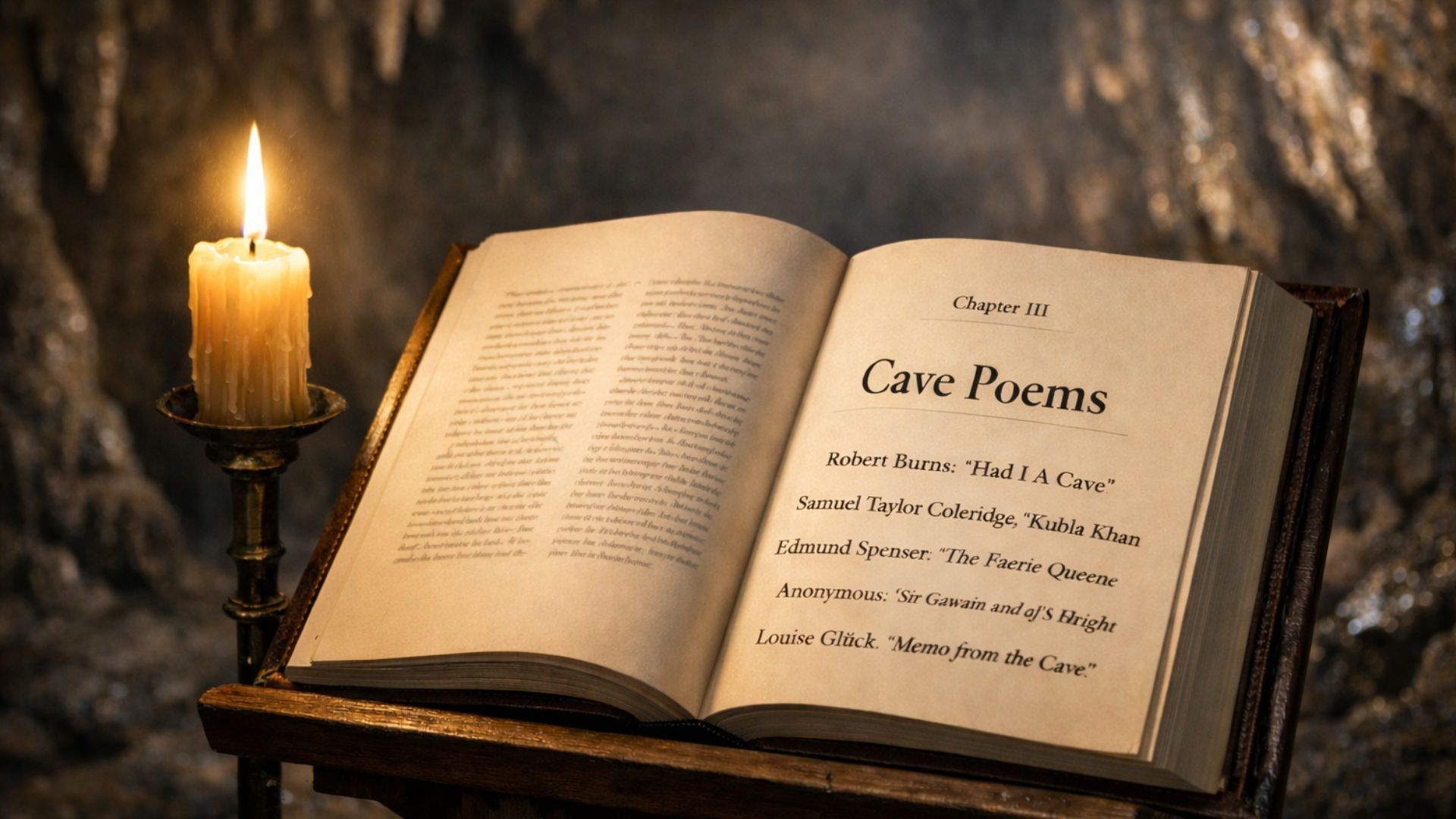
Robert Burns: "Had I A Cave"
Many of Burns's poems were written for music, and "Had I A Cave" is marked as a song.
It's a song of disappointment and grief – a blues, if you will. The speaker, it seems, has been let down by a false lady whose "fond, plighted vows" were as "fleeting as air". He wants nothing more than to escape to a cave and quietly fade away. Poor chap…
Had I a cave on some wild distant shore,
Where the winds howl to the wave's dashing roar:
There would I weep my woes,
There seek my lost repose,
Till grief my eyes should close,
Ne'er to wake more!
Samuel Taylor Coleridge: "Kubla Khan"
Many people have dreamt wild dreams after falling asleep over a book. But few have taken those dreams and turned them into poetry as vivid and fantastical as the 19th-century Romantic poet Samuel Taylor Coleridge.
According to his own account, Coleridge came up with "Kubla Khan" after falling asleep reading about the medieval Chinese king of the same name.
"On awaking," Coleridge wrote, "[he] eagerly wrote down the lines that are here preserved." However, "he was unfortunately called out by a person on business from Porlock… and on his return to his room, found… with the exception of some eight or 10 scattered lines and images, all the rest had passed away".
It was this unfortunate interruption that left "Kubla Khan" a fragment rather than a complete poem. But even in its unfinished state, it contains many memorable lines, including "caverns measureless to man" and "a sunny pleasure-dome with caves of ice".
Edmund Spenser: The Faerie Queene
Edmund Spenser's late 16th-century poem, The Faerie Queene, is a spectacularly ambitious work. Hitting more than 36,000 lines and 4,000 stanzas, it's a narrative poem full of knights, giants, nymphs, ladies and shepherds.
Not content with creating a poem of such epic length, Spenser also invented his own verse form, now known as the "Spenserian stanza".
In the first book of The Faerie Queene, the Redcrosse Knight enters the Cave of Despair. There, he meets the allegorical figure of Despair, who does his best to derail the knight's mission:
He there does now enjoy eternall rest
And happie ease, which thou doest want and crave,
And further from it daily wanderest:
What if some little paine the passage have,
That makes fraile flesh to feare the bitter wave?
Is not short paine well borne, that brings long ease,
And layes the soule to sleepe in quiet grave?
Sleepe after toyle, port after stormie seas,
Ease after warre, death after life does greatly please.
Thankfully for the knight, however, the beautiful princess Una intervenes and helps him triumph over Despair.
Read The Faerie Queene in full.
Anonymous: Sir Gawain and the Green Knight
Written in Middle English, Sir Gawain and the Green Knight is a romance poem about a knight who accepts a challenge from a mysterious Green Knight.
Gawain is invited to strike the Green Knight with an axe – on the condition he receives an identical blow at the Green Chapel in a year's time. Gawain accepts the quest and undertakes a journey of temptation and honour.
The story ends outside the Green Chapel, described (in translation) as "all overgrown everywhere with patches of grass… all hollow within, nothing but an old cave, or a crevice of an old crag".
Some scholars believe that the anonymous Gawain-poet was inspired by Lud's Church, a natural chasm in the Staffordshire Moorlands. It shares with the Green Chapel a mossy, rocky structure and an eerie atmosphere.
Like the identity of the Gawain-poet, however, the exact inspiration for the Green Chapel remains uncertain.
Read Sir Gawain and the Green Knight in full.
Louise Glück: "Memo from the Cave"
We circle back to where we began – a poem about a cave that's also a poem about despair, this time by the American poet Louise Glück.
Her cave, however, is fully metaphorical – a domestic sphere where "Alibis hang upside-down / Above the pegboard" and "My lies are crawling on the floor".
In this emotional cave, despair has replaced love: "I've let / Despair bed / Down in your stead / And wet / Our quilted cover".
In Spenser's Faerie Queene, the Redcrosse Knight leaves the Cave of Despair. Will the speaker of Glück's poem get out, too?
Read "Memo from the Cave" in full.
Poets have used caves to express the full range of the human experience – from discovery to despair. But here at our caves in the Yorkshire Dales, it's fun, surprise and adventure all the way down. Feeling inspired? Join us at Stump Cross Caverns for a day out you'll never forget. It's easy to book your tickets online.